
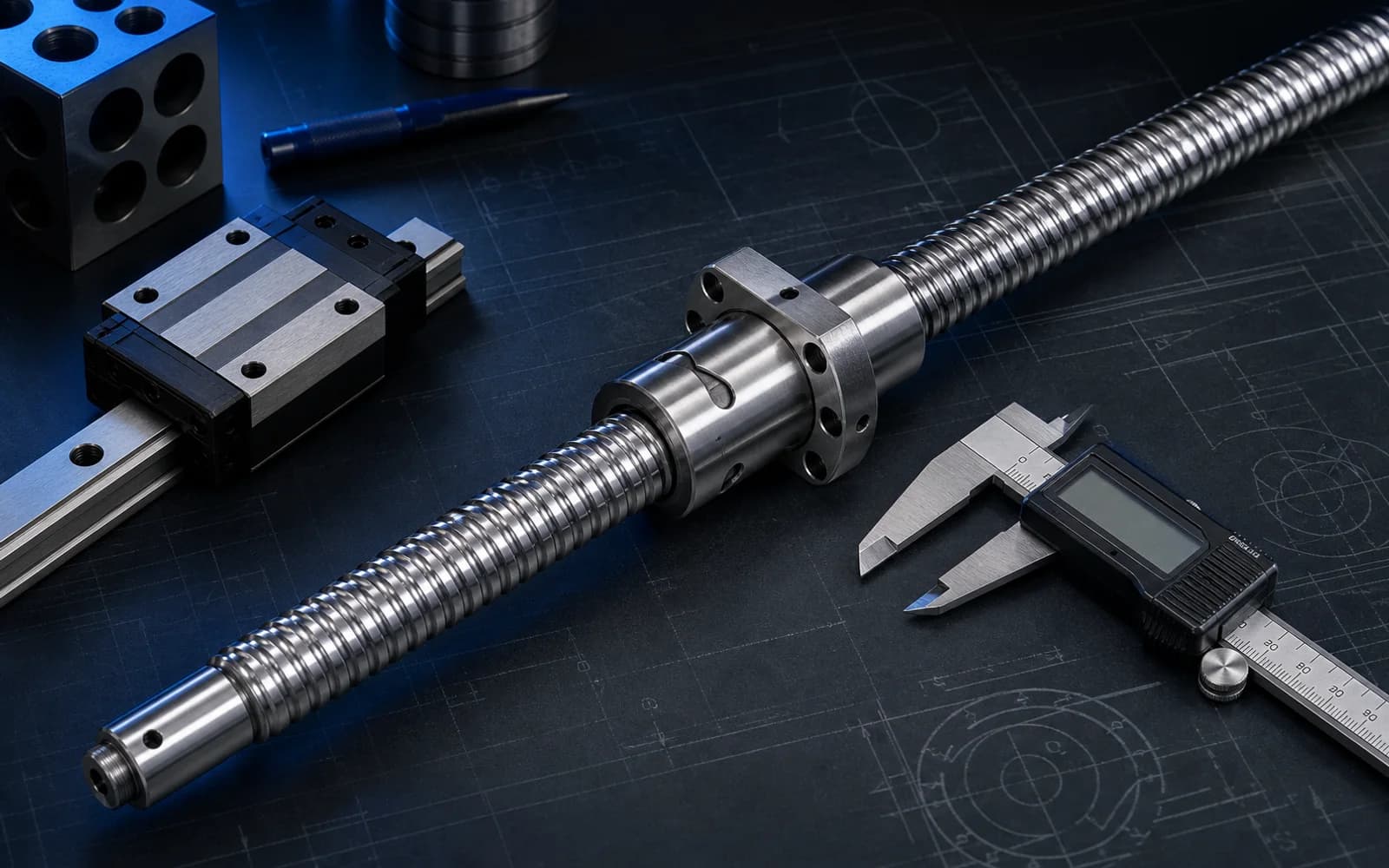
A ball screw converts rotary motion into precise linear motion with high efficiency. It is widely used in CNC equipment, laser machines, linear modules, assembly systems and other industrial automation applications. Selecting the right model requires more than matching the screw diameter to the available installation space. Load, speed, accuracy, service life and operating conditions must be evaluated together.
1. Define the load and motion profile
Start with the maximum axial load, average operating load, acceleration, travel distance and duty cycle. Include the weight of the moving assembly as well as external machining or process forces. Shock loads and emergency-stop conditions should also be considered because they can be significantly higher than the normal running load.
2. Select the screw diameter
The screw shaft must resist axial load, buckling and excessive vibration. A longer unsupported length or a higher compression load normally requires a larger diameter. For long vertical or high-speed axes, verify the allowable axial load and critical speed instead of selecting diameter by experience alone.
3. Choose the correct lead
Lead is the linear distance traveled during one revolution. A larger lead provides higher linear speed at the same motor speed, while a smaller lead provides greater mechanical advantage and finer positioning resolution. The selected lead should balance target speed, motor torque, acceleration and control resolution.
4. Match the accuracy grade to the application
Positioning accuracy, repeatability and lead error determine the required accuracy grade. Precision-ground ball screws are commonly selected for demanding machine-tool and measurement applications. Rolled ball screws can provide a cost-effective solution for general automation where extreme lead accuracy is not required.
5. Evaluate preload and axial clearance
Preload reduces axial play and improves rigidity, but excessive preload increases friction, heat and drive torque. Light preload is often suitable for positioning equipment, while higher rigidity applications may require a more carefully specified preload. The correct value depends on the load variation, accuracy target and thermal conditions.
6. Confirm the support and mounting arrangement
Common arrangements include fixed-supported, fixed-fixed and fixed-free mounting. The support configuration affects rigidity, allowable speed and thermal expansion behavior. Confirm the end-machining dimensions, bearing units, nut flange orientation and available assembly space before production.
7. Check speed, lubrication and environment
Verify the screw speed, DN value and expected operating temperature. Use the lubricant type and replenishment interval recommended for the application. Covers, bellows or sealing systems may be required in environments containing dust, metal chips, cutting fluid or other contaminants.
Information to send your supplier
For an efficient quotation, provide the required stroke, total screw length, axial load, maximum speed, positioning accuracy, mounting method, motor data, working environment and any end-machining drawing. These details allow the supplier to verify service life, critical speed, buckling safety and installation compatibility before confirming the model.
HS LASERTECH can help evaluate standard and customized ball screw assemblies for industrial automation equipment. Share your application data or drawing with our team to receive a model recommendation and quotation.