
Selecting an industrial automation parts supplier affects far more than the purchase price. The supplier must understand the application, match components correctly, control quality, prepare export documents, and respond when a problem occurs. This guide gives overseas buyers, machine builders, and maintenance teams a practical framework for comparing potential partners.
Key Takeaways
- Evaluate technical capability and application understanding before comparing prices.
- Ask how products are sourced, inspected, documented, packed, and traced.
- Confirm customization, lead times, export support, and after-sales responsibility in writing.
- Use a small trial order to verify communication and execution before scaling up.
1. Check Product Scope and Application Knowledge
A capable supplier should understand the differences between reducers, gears, guideways, linear modules, motors, bearings, and related automation components. A broad catalog is useful only when the team can identify the correct model for the machine.
Send a real application example and observe the questions you receive. A reliable supplier normally asks about power, torque, speed, load, precision, duty cycle, mounting dimensions, environment, and delivery requirements. If the discussion focuses only on model number and price, important risks may be overlooked.
2. Verify Company and Export Qualifications
Request the company’s business license, export qualification information, customs registration details, and relevant certificates. Make sure quotations, contracts, invoices, and payment beneficiary information use consistent company details. This basic review helps establish who is responsible for the transaction and after-sales support.
For international orders, also confirm experience with commercial invoices, packing lists, certificates of origin, bills of lading, inspection documents, and destination-specific customs requirements.
3. Understand the Supply Model
Some suppliers operate a single factory, while trading companies and integrated suppliers cooperate with several specialized manufacturers. Neither model is automatically better. A factory may offer deep expertise in a narrow product line, while a multi-source supplier can consolidate several automation components and support cross-brand matching.
Ask which products are made directly, which are sourced from partners, and who performs incoming or pre-shipment inspection. The supplier should clearly explain its role rather than creating confusion about the source.
4. Review Quality-Control Procedures
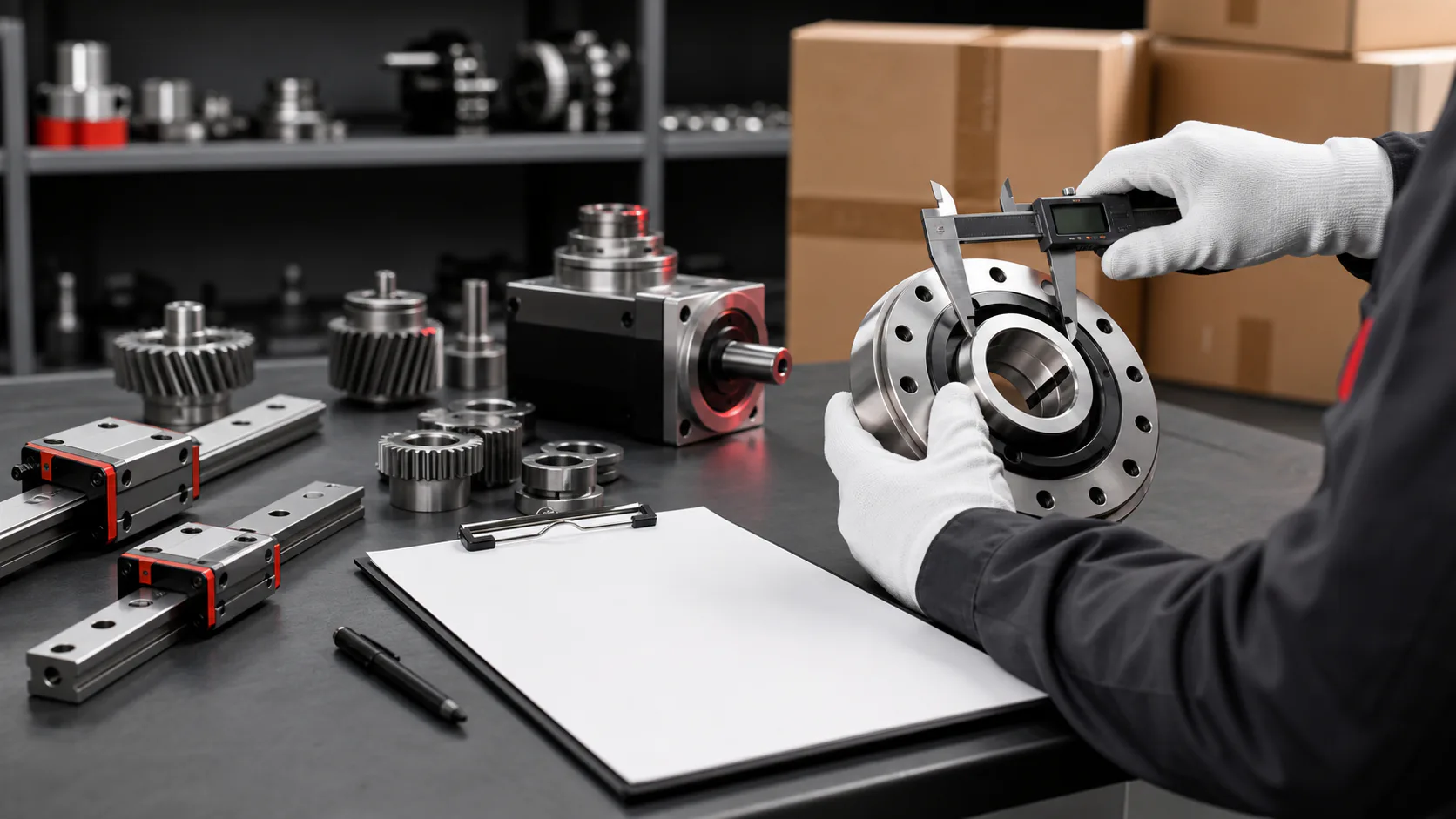
Quality control should match the product and order. Useful checks may include model and quantity verification, dimensional inspection, appearance inspection, nameplate confirmation, rotation or functional checks, packaging review, and photo or video records before shipment.
For customized components, request approved drawings or technical specifications before production. Define critical dimensions, materials, tolerances, interface requirements, and acceptance criteria. Clear documentation reduces disagreement later.
5. Evaluate Customization Capability
Automation projects often require non-standard speed ratios, shafts, flanges, mounting holes, stroke lengths, motor adapters, sensors, cable directions, or logo marking. A supplier should explain what can be customized, the minimum quantity, engineering lead time, tooling requirements, and drawing-confirmation process.
Be cautious when every customization request is accepted immediately without technical questions. Responsible customization includes feasibility review and written confirmation.
6. Compare Lead Time and Delivery Reliability
Separate stock availability from production lead time. Ask whether quoted items are physically in stock, allocated from a manufacturer, or produced after order confirmation. For mixed orders, confirm whether goods will ship together or in partial batches.
Delivery planning should include production, inspection, export packing, domestic transport, customs preparation, and international shipping. A realistic schedule is more valuable than an aggressive promise that cannot be maintained.
7. Assess Communication and Documentation
Good communication is accurate, traceable, and timely. Quotations should identify brand, model, quantity, unit price, trade terms, lead time, payment terms, warranty conditions, and quotation validity. Technical drawings and revisions should have clear version control.
When comparing suppliers, record how quickly they respond, whether answers are complete, and whether one contact person takes ownership of the order.
8. Confirm After-Sales Responsibility
Ask what happens if a product is damaged, incorrectly supplied, or fails during use. The supplier should have a defined process for collecting evidence, analyzing the cause, coordinating with manufacturers, and offering repair, replacement, spare parts, or another agreed solution.
Before ordering, clarify the warranty scope, excluded conditions, required installation records, and who pays shipping under different outcomes.
Supplier Evaluation Checklist
- Valid business and export documentation
- Relevant product range and application knowledge
- Clear manufacturer or sourcing relationships
- Documented inspection and traceability process
- Engineering support and customization workflow
- Transparent quotation and payment information
- Realistic production and shipping schedule
- Export packing and customs-document capability
- Written warranty and problem-resolution process
- References, sample records, or a successful trial order
Frequently Asked Questions
Is a factory always better than a trading company?
No. A factory may provide specialized manufacturing depth, while a qualified trading or integrated supplier may offer a broader range, consolidated purchasing, cross-brand matching, export coordination, inspection, and one-stop after-sales support. The better choice depends on your sourcing needs.
Should I place a trial order first?
A small trial order is a practical way to evaluate quotation accuracy, technical communication, product quality, packing, documentation, delivery, and problem handling before committing to a larger purchasing program.
What information should I send for a quotation?
Provide the product model or drawing, quantity, application, technical parameters, preferred brand, customization needs, destination, delivery deadline, and requested trade terms. Photos and nameplates are useful for replacement parts.
Conclusion
The best industrial automation parts supplier combines product knowledge, transparent sourcing, quality control, export execution, and accountable after-sales service. Use the checklist above, begin with a defined trial order, and evaluate performance with evidence. Explore our industrial automation components or send us your sourcing list for a coordinated quotation.