
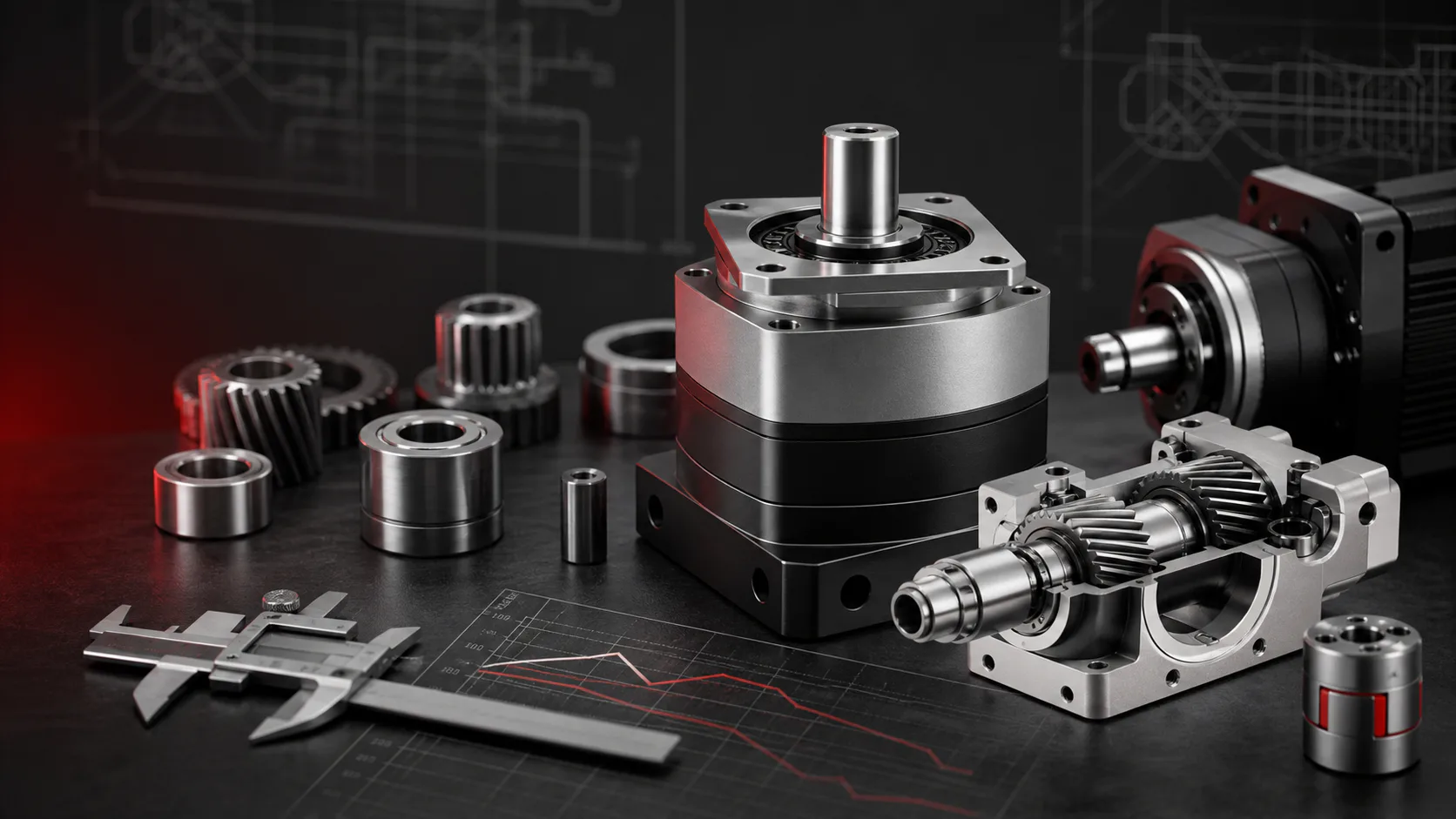
Choosing an industrial gear reducer is not simply a matter of matching motor power. The correct unit must deliver the required output torque and speed while fitting the machine, surviving the operating environment, and providing an acceptable service life. This guide gives equipment builders, maintenance teams, and purchasing managers a practical way to compare options before requesting a quotation.
Key Takeaways
- Start with output torque, input speed, required output speed, and service conditions.
- Confirm ratio, reducer type, mounting position, shaft arrangement, and available installation space.
- Allow a suitable service factor for shock loads, frequent starts, reversing, and long daily operation.
- Send complete application data to the supplier instead of selecting only by motor power.
1. Define the Required Speed Ratio
The speed ratio determines how much the reducer lowers motor speed. Calculate the preliminary ratio by dividing motor speed by the desired output speed. For example, if a motor runs at 1,500 rpm and the driven machine needs about 50 rpm, the preliminary ratio is 30:1. The final selection should also consider the actual rated speeds available in the manufacturer’s product range.
Remember that a reducer changes both speed and torque. A higher ratio normally produces a lower output speed and higher available output torque, but efficiency, allowable load, and thermal limits still need to be checked.
2. Calculate Output Torque and Service Factor
Required output torque is one of the most important selection values. It should include the continuous working load as well as acceleration, peak load, and possible jam conditions. Machines with smooth, steady loads can use a different service factor from conveyors with frequent starts, indexing tables, crushers, or equipment that reverses direction repeatedly.
Provide the supplier with the motor power, motor speed, operating hours per day, starts per hour, load type, and expected peak torque. This allows the reducer to be checked for both mechanical strength and thermal capacity.
3. Choose the Appropriate Reducer Type
Different reducer designs suit different priorities:
- Planetary reducers are often selected for compact size, high torque density, and precision motion.
- Worm reducers provide a right-angle arrangement and a simple, economical structure for many general applications.
- Helical reducers are widely used where efficiency, stable operation, and continuous duty are important.
- Bevel gear reducers transmit power at an angle and are useful when the machine layout requires a right-angle shaft arrangement.
- Harmonic reducers are considered for high-ratio, compact precision systems where low backlash is important.
The best choice depends on the complete application, not on one feature alone.
4. Confirm Mounting and Mechanical Interfaces
Check the mounting position, flange pattern, foot mounting dimensions, input interface, output shaft diameter, keyway, hollow shaft size, and rotation direction. A technically suitable reducer can still be unusable if the shaft arrangement or installation envelope does not match the machine.
When replacing an existing reducer, send the model plate, dimension drawing, photos from several angles, and measured shaft dimensions. For new equipment, provide a 2D drawing or 3D installation envelope whenever possible.
5. Review Precision, Backlash and Load Capacity
Automation equipment may require controlled positioning, repeatability, and low backlash. Confirm whether the application is simple power transmission or precision motion control. Also check radial and axial loads on the output shaft. Sprockets, pulleys, timing belts, and overhung loads can place significant force on the bearings even when transmitted torque appears acceptable.
6. Consider the Operating Environment
Temperature, dust, moisture, washdown, corrosive materials, altitude, and indoor or outdoor installation can affect sealing, lubrication, coating, and maintenance requirements. Tell the supplier if the reducer will operate in a clean room, food-processing area, high-temperature workshop, or dusty production line. Special lubricants, seals, surface treatments, or protection levels may be necessary.
Industrial Gear Reducer Selection Checklist
- Motor power and rated input speed
- Required output speed and calculated ratio
- Continuous, peak, and emergency torque
- Duty cycle, daily operating hours, and starts per hour
- Load characteristics: uniform, moderate shock, or heavy shock
- Mounting position and available installation space
- Input and output shaft or flange dimensions
- Backlash and positioning requirements
- Radial and axial loads
- Ambient temperature and environmental conditions
Frequently Asked Questions
Can I select a reducer only by motor power?
No. Motor power is only one input. Output torque, ratio, duty cycle, peak load, mounting position, shaft loads, and environmental conditions must also be considered to avoid premature failure or an oversized solution.
Can an existing reducer be replaced with another brand?
Often yes, but the replacement must be checked for ratio, torque, input and output interfaces, mounting dimensions, shaft direction, backlash, and operating conditions. A model plate and dimensional drawing make cross-reference work more reliable.
Can the speed ratio and shaft dimensions be customized?
Many reducer series support non-standard ratios, flanges, shafts, adapters, or mounting dimensions. Custom feasibility depends on quantity, design limits, and application data, so detailed drawings should be confirmed before production.
Conclusion
The right industrial gear reducer balances torque, speed, durability, precision, installation, and total operating cost. Prepare a complete application checklist before comparing models. To discuss a standard or customized solution, review our industrial automation products or contact our team with your motor and load information.