
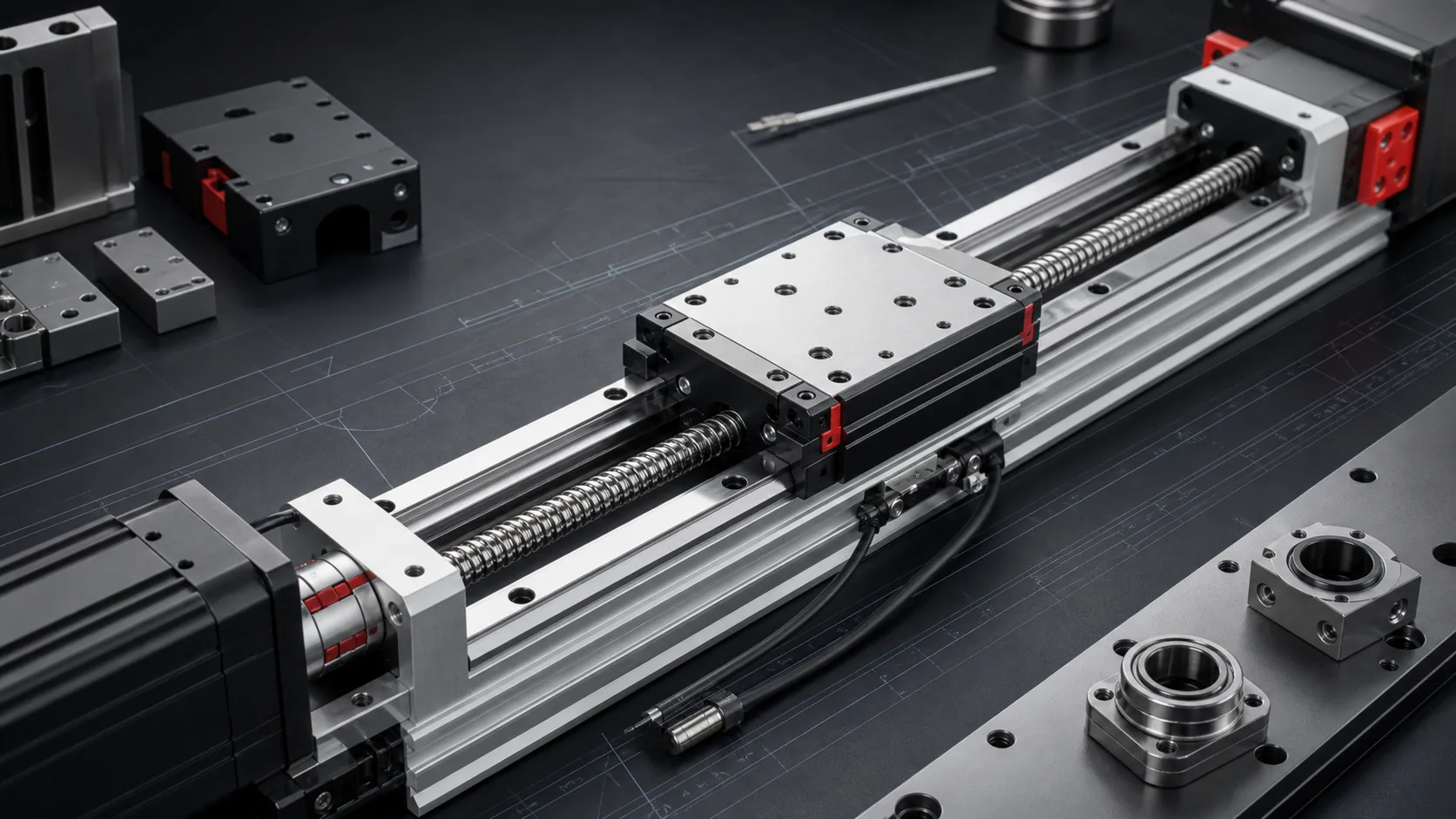
A linear module converts rotary motor motion into controlled straight-line movement. It can simplify machine design, but only when its load capacity, travel, speed, accuracy, and mechanical interfaces match the application. This guide helps machine builders and purchasing teams prepare the information needed for a reliable selection.
Key Takeaways
- Define payload, stroke, speed, acceleration, duty cycle, and mounting direction first.
- Choose between ball-screw and belt drive according to precision, travel, speed, and load.
- Check moment loads as well as the payload weight.
- Confirm motor interface, sensors, lubrication, cable routing, and environmental protection before ordering.
1. Define the Motion Profile
Start with the required stroke, cycle time, maximum speed, acceleration, deceleration, and number of cycles per day. A module that can carry the static load may still be unsuitable when the application has rapid acceleration or continuous high-speed operation. Provide a simple motion sequence showing travel distance, move time, dwell time, and return time.
Also distinguish usable stroke from total module length. End supports, bearing blocks, limit space, and safety overtravel make the overall assembly longer than its rated travel.
2. Calculate Load and Moment Forces
Payload is only the beginning. The distance between the payload center of gravity and the carriage creates pitch, roll, and yaw moments. Vertical mounting also changes the load direction and may require a brake or counterbalance to prevent the axis from dropping when power is removed.
Tell the supplier the payload mass, center-of-gravity position, mounting orientation, external forces, and whether more than one carriage is required. A drawing is usually more useful than a single load value.
3. Compare Ball-Screw and Belt-Driven Modules
Ball-screw linear modules are commonly used when positioning accuracy, rigidity, and controlled thrust are priorities. They are well suited to assembly, inspection, dispensing, and positioning tasks with moderate stroke and speed.
Belt-driven linear modules are often preferred for longer travel and higher speed. They can be a practical solution for transfer, pick-and-place, packaging, and material-handling systems. Belt tension, payload, acceleration, and repeatability requirements must still be checked.
No drive type is universally better. Selection should follow the motion profile and total application requirements.
4. Understand Accuracy and Repeatability
Accuracy describes how closely the carriage reaches the commanded position across the working range. Repeatability describes how consistently it returns to the same position. Many automation tasks need excellent repeatability but do not require the same absolute accuracy. Defining the real requirement can prevent unnecessary cost.
Also consider backlash, straightness, parallelism, rigidity, and deflection under load. For inspection or precision assembly, the machine frame and mounting surface can influence final system performance as much as the module itself.
5. Select the Guide and Carriage Arrangement
Guideway size and carriage spacing affect load capacity and moment resistance. A wide load or an offset tooling plate may need two carriages or parallel modules connected by a rigid beam. When using parallel axes, alignment and synchronized drive design are important to prevent binding.
6. Confirm Motor, Sensors and Controls
Specify whether the axis will use a servo motor, stepper motor, or another drive. Confirm motor flange, shaft diameter, coupling, gearbox, encoder, brake, and cable direction. Limit switches, home sensors, and intermediate position sensors should be chosen with suitable mounting locations and cable lengths.
If the supplier will provide only the mechanical axis, share the exact motor drawing. If a complete axis is required, also provide the controller voltage, communication interface, and operating sequence.
7. Review Installation and Environment
The mounting base must be flat and sufficiently rigid. Confirm horizontal, vertical, wall, or inverted installation because allowable loads can change with orientation. Dust, metal particles, coolant, humidity, clean-room requirements, and temperature may require covers, bellows, special seals, lubrication, or corrosion-resistant materials.
Linear Module Selection Checklist
- Payload mass and center-of-gravity location
- Horizontal, vertical, wall, or inverted mounting
- Required stroke and total available space
- Maximum speed, acceleration, and cycle time
- Accuracy, repeatability, and backlash targets
- External thrust and moment loads
- Ball-screw or belt-drive preference
- Motor brand, model, flange, brake, and cable direction
- Sensor quantity and mounting requirements
- Environment, lubrication, cover, and protection needs
Frequently Asked Questions
Which is better, a ball-screw or belt-driven linear module?
A ball-screw module is often chosen for rigidity and precise positioning, while a belt-driven module is often suitable for longer, faster travel. The correct choice depends on load, stroke, speed, acceleration, accuracy, duty cycle, and budget.
Can a linear module be mounted vertically?
Yes, many models support vertical mounting, but the axis must be checked for vertical load capacity. A motor brake, counterbalance, or other safety measure may be required to prevent unintended downward movement during power loss.
Can the stroke and motor interface be customized?
Many module series offer multiple strokes, carriage lengths, motor adapters, sensor options, and cable directions. Non-standard dimensions may also be possible when drawings, quantity, and operating requirements are provided.
Conclusion
Selecting a linear module becomes easier when the motion profile, load, precision, interfaces, and environment are defined together. Browse our automation component range or send your application drawing for model matching and customization support.